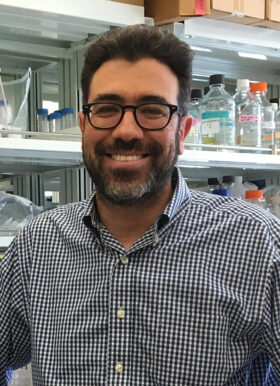
Brian Edelson, MD, PhD
Associate Professor, Pathology & Immunology
Contact
- Email: bedelson@wustl.edu
- Phone: 314-362-4427
Division: Laboratory & Genomic Medicine
Titles
Co-Leader, Gateway Curriculum, Phase 1 Module 2 “Defense and Response to Injury”
Washington University School of Medicine Academy of Educators
Education
BS: Brown University, Providence RI (1995)
PhD, MD: Washington University School of Medicine, St. Louis, MO (2004)
Residency, Clinical Pathology: Barnes-Jewish Hospital, St. Louis, MO (2009)
Postdoctoral Work: Washington University School of Medicine, St. Louis, MO (2010)
Boards
Diplomate, Missouri State Board of Registration for the Healing Arts
American Board of Pathology, Clinical Pathology
Related Links
DBBS Affiliations
Immunology
Molecular Microbiology and Microbial Pathogenesis
Research Interests
My laboratory is focused on two areas of immunology. First, we are interested in understanding how autoreactive T cells mediate autoimmune disease, particularly in multiple sclerosis (MS) and its mouse model, experimental autoimmune encephalomyelitis (EAE). We focus on how cytokine expression is regulated in autoreactive T cells in a cell-intrinsic manner through the action of transcription factors, and how these cytokines mediate disease pathogenesis. We are particularly interested in how T cell expression of granulocyte-macrophage colony stimulating factor (GM-CSF) and interleukin-10 (IL-10) is regulated, and how these cytokines act on cells of the innate immune system during autoimmune disease. My laboratory’s work in this area led to our discoveries that the transcription factor Bhlhe40 and the ZFP36 family of RNA binding proteins regulate cytokine production by T cells. Second, we are interested in understanding the development, heterogeneity, and function of monocytes, macrophages, and dendritic cells during immune responses. We use a variety of gene-deficient mice to analyze how specific monocyte, macrophage, and dendritic cell subsets carry out their non-redundant roles during autoimmunity and infection. We employ mouse models of Listeria monocytogenes and Heligmosomoides polygyrus infections in many of these experiments.
Selected Publications
Empty
Publication
Assistant
