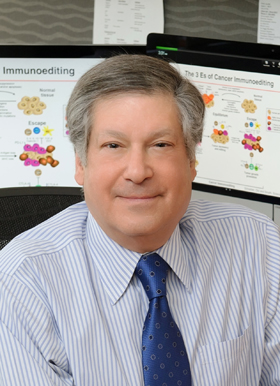
Robert Schreiber, PhD
Andrew M. and Jane M. Bursky Distinguished Professor, Pathology & Immunology
Contact
- Email: rdschreiber@wustl.edu
- Phone: 314-362-8787
Titles
Director, Center for Human Immunology and Immunotherapy Programs
Co-Leader, Tumor Immunology Program, Siteman Comprehensive Cancer Center
Director, T32 Training Grant in the Immunobiology and Cell Biology of Cancer (NCI)
Education
BA: (Chemistry) State University of NY at Buffalo (1968)
PhD: (Biochemistry/Immunology) State University of New York at Buffalo (1973)
Postdoc: (Immunology) Research institute of Scripps Clinic (1973-1976)
Additional Professional Memberships
Extramural Member Researcher, Parker Institute for Cancer Immunotherapy
Member, Board of Scientific Advisors, National Cancer Institute
Associate Director, Scientific Advisory Board, Cancer Research Institute
Co-Editor in Chief, Cancer Immunology Research
Recognition
Fellow of the AACR Academy (2019)
Honoris Causa Diploma, University of Buenos Aires (2017)
Balzan Prize (Shared with James Allison): Immunological Approaches in Cancer Therapy (2017)
Organizer, Keystone Symposium, “Cancer Immunology and Immunotherapy: Taking a Place in Mainstream Oncology (2017)
Member, Biden Blue Ribbon Panel on Cancer Moonshot (2016)
Organizer, Society for Immunotherapy of Cancer, “Workshop on New Perspectives (2015)
Heath Memorial Award, The University of Texas MD Anderson Cancer Center (2015)
AACR Lloyd J. Old Prize in Cancer Immunology (2014)
Organizer, Inaugural Meeting of International Cytokine and Interferon Society (2013)
Member, National Academy of Sciences (2012)
Member, American Academy of Arts and Science (2010)
Carl and Gerty Cori Faculty Achievement Award, Washington University (2008)
Distinguished Investigator Award, Washington University School of Medicine (2008)
The Charles Rodolphe Brupbacher Prize for Cancer Research (2007)
Member, Kennedy Institute of Rheumatology, Scientific Advisory Board (2002)
Organizer, Keystone Symposium, “Jaks and Stats: Development to Disease” (2004)
Associate Director of the Scientific Advisory Council, Cancer Research Institute (2002-)
Coley Award for Distinguished Research in Basic and Tumor Immunology, Cancer Research Institute (1996)
Marie T. Bonazinga Award for Excellence in Leukocyte Biology Research (1998)
Fellow of the American Association for the Advancement of Science (1996)
Milstein Award for Outstanding Achievements in Interferons and Cytokines International Society of Interferon and Cytokine Research (1996)
Merit Award Grant #CA 43059, National Cancer Institute (1995-2002)
Recipient, American Heart Association Established Investigatorship 77-202 (1977-1982)
Recipient, National Institutes of Health Predoctoral Fellowship (1970-1972)
DBBS Affiliation
Immunology Program
Research Interests
My research is focused on elucidating the cellular and molecular mechanisms underlying natural and therapeutically induced immune responses to developing and established cancers. My group was the first to propose the concept of “Cancer Immunoediting” wherein the immune system not only protects against cancer but also favors cancer outgrowth by shaping tumor cell immunogenicity. We went on to provide strong experimental evidence supporting each of the three phases of the cancer immunoediting process—Elimination, Equilibrium and Escape. We produced a variety of gene-targeted mice and used them to obtain genetic evidence for the roles of various cytokines, receptors and signaling pathways in the cancer immunoediting process. In the process, we also developed a model of mouse mammary cancer that displays remarkable similarities to human luminal breast cancer. During my career, my lab generated a number of key monoclonal antibody reagents that neutralize cytokines or block cytokine receptors and validated their in vivo use to assess the role of cytokines in preventing or inducing diseases particularly cancer.
Most recently, my group pioneered the use of immunogenomics approaches to rapidly identify immunogenic tumor-specific neoantigens and target them therapeutically. Our work now focuses on optimizing the use of therapeutic neoantigen vaccines (in combination with other forms of cancer therapy and immunotherapy) to treat solid and hematopoietic malignancies. In all, my 44 years of laboratory based research has led to the publication of in 267 peer-reviewed papers and 64 reviews resulting yielding an h-index of 124 (ISI Web of Science).
In addition to my primary research career, I have also been consistently involved in graduate and postdoctoral trainee education. I have mentored 27 Ph.D. students (including 13 MD/PhD students) and 39 postdocs, led the Immunology Training Program at Washington University from 1993-2003 and was the Director of the T32 Program in Immunology for 10 years. In 2003 I stepped down from those positions to take over as Director of the NCI T32 funded program in Cancer Biology (now the T32 Program in the Immunobiology and Cell Biology of Cancer) since it more closely aligned to my research interests. I have led that program for 18 years.
Selected Publications
Radionuclide-stimulated dynamic therapy induces complementary immunogenic necroptosis and apoptosis cancer cell death pathways
Publication
mRNA vaccines engage unconventional pathways in CD8<sup>+</sup> T cell priming
Publication
Cancer Neoantigen Vaccines Emerge Efficacious
Publication
Cancer Immunosurveillance: Immunoediting
Publication
Assistant

Lab Phone: 314-362-8746
Office Location: BJC-IH Building, Office Suite C 8417