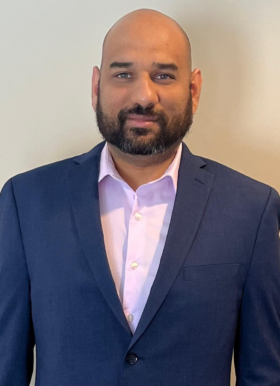
For this Faculty Feature, we highlighted Umang Jain, an Assistant Professor in the Anatomic & Molecular Pathology Division.
Tell us about your background. Where did you grow up, and when did you first become interested in science and medicine?
I was raised in Kanpur, India, where my interest in science was shaped early on by my father, a physician and educator who introduced me to medicine and human biology. As I progressed through school, I became increasingly drawn to biology, especially through projects that allowed me to explore how living systems function beyond the classroom. This growing curiosity was further reinforced by early exposure to research during my academic training, ultimately leading me toward a path in biomedical science.
What is your career path?
After completing my Master’s, I began my research career at Syngene International, a collaborative venture between Biocon and Bristol Myers Squibb. I subsequently moved to Canada to pursue doctoral training under the supervision of Dr. Andrew Standyk, where my research focused on the role of the complement system in enteric infections.
Building on this foundation, I pursued a postdoctoral fellowship jointly supported by Boehringer Ingelheim and Washington University in St. Louis in the Stappenbeck Lab, where I studied how gut microbes regulate intestinal wound repair.
In January 2023, I established my independent research laboratory, focused on investigating the relationship between gut microbiota and health.
What are your favorite parts of your current role?
One of the most rewarding aspects of my current role is the opportunity to collaborate across disciplines. Bringing together expertise in microbiology, immunology, bioinformatics, and clinical research enables a more integrated approach to scientific discovery and helps generate questions that are both mechanistically insightful and clinically relevant.
What is a memorable moment you’ve had while working in the department?
One of the most memorable moments for me was opening my laboratory in 2023 and welcoming the very first members of my team. After years of training, it was incredibly rewarding to see the lab evolve from an idea into a space where people could work together, exchange ideas, and grow scientifically. Some of my favorite moments are the everyday interactions in the lab — discussing new data, troubleshooting experiments together, and watching trainees gain confidence and independence in their research.
What special skills or talents do you have that people may not know about?
A skill I have developed over the past few years is gardening. What started as a simple idea to make the garden “look a bit better” has slowly turned into a hands-on hobby with mixed but improving results. I’ve learned how to plan outdoor spaces, choose plants (sometimes successfully), and carry out small landscaping projects without completely turning the garden into a construction site. It’s been a rewarding process seeing gradual improvements over time, and I find it relaxing.
What are some of your favorite hobbies or activities?
Over the last few years, most of my free time has been centered around my family. I enjoy spending time outdoors with my wife, children, and dog, and I like being involved in my children’s classes and activities. These moments help me stay balanced and recharged outside of work.
What is your advice to aspiring people in your field?
My advice would be to embrace the iterative nature of research, recognizing that challenges and setbacks are an integral part of the discovery process and often lead to important insights. Also seek strong mentorship while gradually developing independent scientific thinking and decision-making skills. Finally, prioritize collaboration and clear communication, as sharing ideas and working across disciplines significantly enhances the quality and the translational potential of scientific research.