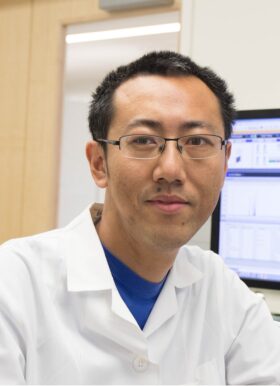
For this Faculty Feature, we highlighted Jiye Cheng, an Assistant Professor in the Laboratory and Genomic Medicine Division (Gordon Lab).
Tell us about your background. Where did you grow up, and when did you first become interested in science and medicine?
I grew up in Dalian, a beautiful seaside city in China that is also well known as a “soccer city.” Soccer was a big part of my childhood—I played almost every day after school and watched as many games as I could. At one point, I dreamed of becoming a professional player. As I got older, I realized that path might not be realistic for me. Instead, it gradually shifted into a new goal: I became interested in the idea of working in medicine with a professional soccer team, helping athletes stay healthy and perform at their best. I think that was the first moment I became truly interested in science and medicine, and it eventually led me down the path I’m on today.
What is your career path?
My career path has followed a fairly traditional route as an international student. After completing my undergraduate studies in China, I was offered the opportunity to pursue my PhD at The Ohio State University.
After graduating from OSU, I joined the lab of Jeffrey Gordon, who had a clear vision to build mass spectrometry capacity for studying gut microbiome–derived metabolites. I was fortunate to be brought on as a mass spectrometrist to help build this capability from the ground up, and over time, this effort grew into a state-of-the-art mass spectrometry facility.
While developing analytical methods and protocols to quantify microbiome-derived metabolites, I became increasingly fascinated by the chemical capabilities of the microbes living in our gut—they truly act as resident chemists within our bodies. With Jeff’s great mentorship and support, I gradually took on more responsibility in leading projects and mentoring students, which, over time, allowed me to transition into my current role as a Research Assistant Professor.
What are your favorite parts of your current role?
One of my favorite parts of my current role is the opportunity to explore novel chemistry possessed by the gut microbiome and to elucidate how molecules derived from these processes directly impact host physiology. The microbes living in our gut have an incredible and largely untapped chemical capacity, and discovering new metabolites feels like uncovering a hidden layer of biology.
I especially enjoy connecting these chemical discoveries to real biological outcomes—how they influence gut barrier function, metabolism, and overall health. It is very rewarding to see how fundamental research can quickly translate into meaningful insights about human biology and potentially inform new therapeutic strategies.
Another aspect I value is working closely with students and trainees. Being able to mentor them, share my experience, and watch them grow scientifically is something I find both meaningful and fulfilling.
What is a memorable moment you’ve had while working in the department?
One of the most memorable aspects of working in this department has been the strong sense of community, especially during times when the broader academic environment has felt uncertain or challenging. In those moments, I have seen faculty come together in a very genuine way—openly sharing their perspectives, supporting one another, and working collectively to navigate complex situations. That level of trust and honesty is something I deeply value.
Equally meaningful is the way people in the department—faculty, trainees, and staff—look out for one another. There is a clear commitment not only to professional growth, but also to personal well-being. Whether it’s during periods of broader uncertainty or in day-to-day situations when someone needs support, I have consistently seen people step in with care, understanding, and practical help. That kind of environment makes a real difference and is something I truly appreciate.
What special skills or talents do you have that people may not know about?
One fun skill people may not know about is that although I am not very good at sports myself, I’m a surprisingly effective “swim coach.” I like to joke that I can teach someone who can’t swim to feel comfortable in the water in about two hours. In fact, several of my high school friends learned to swim from me during our graduation pool party. It’s less about technique and more about helping people relax and build confidence—and reminding them that most mammals can swim 🙂
What are some of your favorite hobbies or activities?
I feel fortunate to have grown up in a “soccer city,” and now to be working in what many consider a “chess city.” I’ve developed an interest in chess and have started playing regularly.
Although chess is played quietly and soccer is fast-paced, I find they share a similar mindset. In both, you are constantly scanning the field, identifying patterns, finding weaknesses, and deciding when to act. I really enjoy that strategic aspect. At the same time, chess gives me a sense of internal calm and helps keep my mind active, which I find both relaxing and rewarding.
What is your advice to aspiring people in your field?
My advice would be to stay curious and follow what genuinely excites you. Science can be challenging, and there will always be obstacles along the way, but curiosity and passion can carry you through those moments. If you are truly interested in the questions you’re asking, it becomes much easier to stay motivated and keep moving forward.
I also think it’s important to be patient with yourself and open to learning new things. Many paths in science are not linear, and some of the most meaningful opportunities come from unexpected or surprising results. Being willing to accept and learn from those unexpected outcomes is an important part of the process. Staying curious, being willing to learn, and maintaining that sense of excitement can make a big difference over time.