Clinical Pathology Residency
The Clinical Pathology-only (CP-only) residency track provides a three-year training experience. The first year and a half of training is dedicated to the “core” components of clinical pathology. After this, training time will be devoted to more advanced experiences in laboratory medicine. Throughout training, residents experience all aspects of clinical pathology and develop both the medical and technical expertise for analyzing laboratory-related challenges. This track is well-suited for the trainee who is planning a career in the academic setting. It may be combined with research experience under the Pathology Physician Scientist Training Program (PSTP).
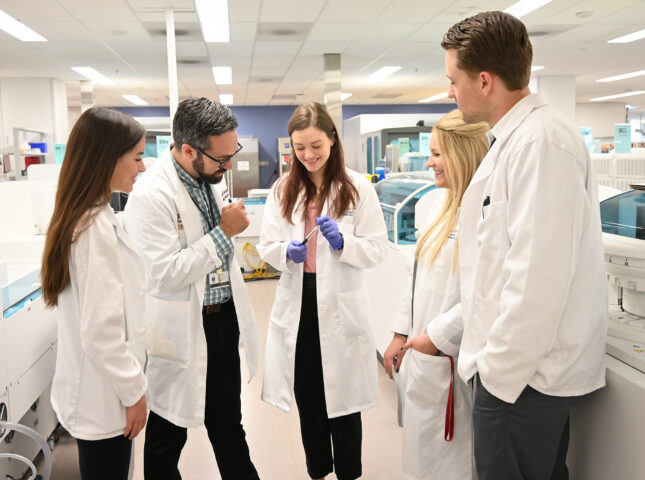
Laboratory medicine is continuously being challenged by an ever-increasing range and complexity of laboratory tests, automation, computerization, and new methodologies. Clinical laboratories rely on medical directors who can evaluate tests and technologies objectively within the proper clinical context, ensuring that treating clinicians have access to the latest and most accurate information to guide patient care decision making. The Clinical Pathology curriculum at WashU Medicine is rooted in five 3-month-long core rotations in each of the major areas of laboratory medicine: 1) Blood Banking and Transfusion Medicine, 2) Clinical Chemistry and Toxicology, 3) Microbiology, Virology, and Serology, 4) Molecular Biology, Immunology, Cytogenetics, Informatics, and Histocompatibility, and 5) Hematopathology and Hematology/Hemostasis. Residents learn the fundamental principles of operation in these laboratories, including the test methodology and instrumentation, as well as obtain experience in the proper selection of tests and the interpretation of data. Residents are closely involved with patient care teams through an call system in each clinical laboratory, where trainees provide direct consultative and interpretive services for treating clinicians. Trainees also work closely with fellows and faculty throughout their clinical pathology training, regularly attending multidisciplinary conferences, participating in high-complexity testing oversight and management, and completing a quality improvement project. In addition to these core rotations, advance elective rotations are available in each of these core areas, as well as in informatics and laboratory management.