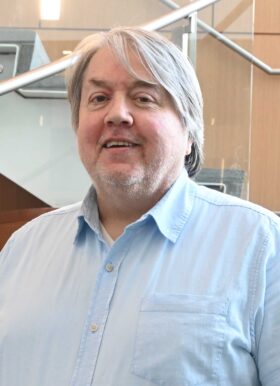
For this Faculty Feature, we highlighted Christopher Nelson, an Associate Professor in the Division of Immunobiology.
Tell us about your background. Where did you grow up, and when did you first become interested in science and medicine?
I grew up on a dairy farm in northern Wisconsin, in a small town of about 700 people called Tigerton. My interest in science was sparked, in large part, by my high school science teacher, Gary Kuchenbecker. Because it was a small school, I remember taking many classes from him, including biology, earth science, anatomy, and chemistry. He made science seem fun, and many of his students pursued careers in science.
What is your career path?
I earned a B.S. in Chemical Engineering in 1985 from the University of Wisconsin–Madison. As an undergraduate, I worked as a research technician in the Biophysics Department in the laboratory of Dr. Paul Kaesberg, a biochemist and virologist recognized for demonstrating that viruses often have icosahedral shapes and for applying X-ray methods to the study of viruses.
After graduation, I began my career at Collaborative Research in Waltham, Massachusetts, where I worked on the Human Genome RFLP Mapping Project in the laboratory of Dr. Helen Donnis-Keller. There, I helped develop the first linkage map of the human genome, which made it possible to identify which chromosome a gene was on and to locate it within about one million base pairs.
I came to Washington University School of Medicine in 1986 to work in Dr. Dennis Loh’s laboratory after reading an article by Philippa Marrack and John Kappler in the February issue of Scientific American called “The T Cell and Its Receptor.” That article was my first introduction to immunology, and I knew then it was the subject I wanted to study. At the time, Dr. Loh’s lab was working on T cell receptors.
After spending a couple of years in Dennis’s laboratory, many people, particularly Ken Murphy, encouraged me to apply to graduate school. I was accepted into the Washington University graduate program in Immunology in 1989, and after a rotation with Dr. Stuart Kornfeld, I joined the laboratory of Dr. Emil Unanue. My thesis work demonstrated that peptides determine the lifespan of major histocompatibility complex class II, or MHC II, molecules in antigen-presenting cells, explaining in part the immunodominance of different peptides. I also used mass spectrometry to sequence the peptides produced by antigen processing and showed how different antigen mutations could alter amino-terminal trimming of MHC II-presented peptides.
During this work, I published a paper with Dr. Daved Fremont entitled “The Crystal Structure of I-Ak in Complex with a Dominant Epitope of Lysozyme.” I became convinced that I needed to learn how to determine protein structures if I wanted to understand the biochemical mechanisms driving the constantly expanding group of molecules involved in the immune system.
In 1998, I joined Dr. Daved Fremont’s laboratory as a research instructor. It was a perfect time to be in structural biology: X-ray methods, detectors, computers, and data-processing software were all evolving rapidly. I am still in Daved’s lab, now as an associate professor, and have used structural biology to study the functions of many different biological systems and viruses. Looking back, it has been a very enjoyable and productive time.
What are your favorite parts of your current role?
There is nothing as enjoyable as solving a new protein structure. So many things must go right for it to work: the protein expression and purification must go well, the data collection must be done correctly, and you must solve the phase problem for an X-ray structure or complete a reconstruction for a cryo-EM structure. When it finally all comes together, you go from having nothing to having a huge amount of information to examine and interpret. It makes all the effort worth it.
What is a memorable moment you’ve had while working in the department?
On January 25, 1998, instead of watching the halftime show for Super Bowl XXXII, William Sha, then a graduate student, and I developed an autoradiograph that proved we had produced a T-cell receptor transgenic mouse engineered to graft-reject its entire body. We honestly didn’t know what would happen when the mouse got old enough for its T cells to start working. The mouse survived, and that study revealed that T cells undergo positive and negative selection during thymocyte development. I am not sure the Institutional Animal Care and Use Committee would let us do that experiment today.
What special skills or talents do you have that people may not know about?
I am very good at persuading milkweed seeds to germinate to provide food for the monarch butterfly migration. Also, having grown up in northern Wisconsin, I learned to polka at a very young age. But I don’t think anyone has seen me dance a polka in 30 years.
What are some of your favorite hobbies or activities?
I enjoy spending time on our farm in northern Michigan. I like being outdoors, gardening, cutting firewood, pouring cement, and devising new ways to eliminate the invasive shrub called common buckthorn. As a hobby, I have built the same world in Minecraft for over 15 years.
What is your advice to aspiring people in your field?
Design your experiments around questions you don’t already know the answers to. Also, make time to get to know your colleagues; I’ve found that many of them have become lifelong friends.