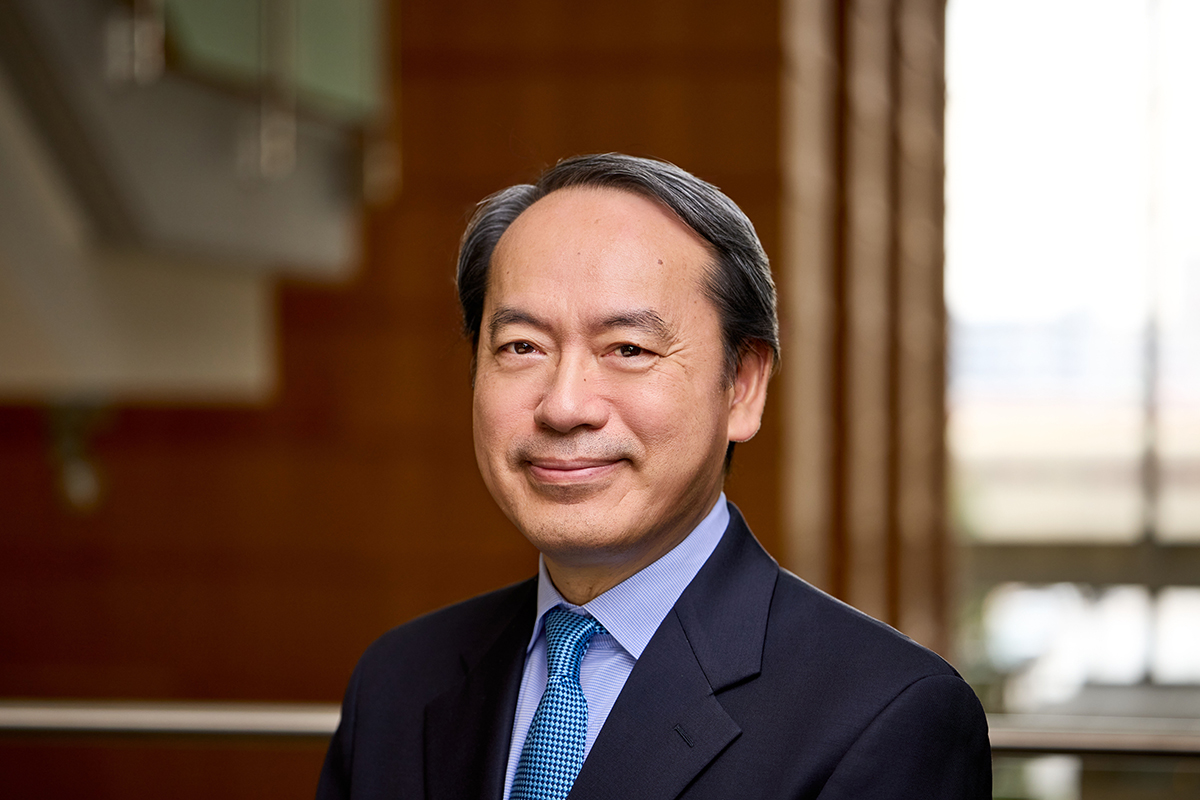
For this Faculty Feature, we highlighted Eric Huang, our Department Chair and the Joseph M. Davie Distinguished Professor.
Tell us about your background. Where did you grow up, and when did you first become interested in science and medicine?
Born in Taichung, I spent my childhood in this small, sleepy city in central Taiwan. While in high school, I developed an interest in math, biology, and chemistry. After high school, I was very fortunate to attend the National Taiwan University College of Medicine in Taipei. There, I developed an interest in basic science research and was aspired to pursue a career as a physician-scientist. To determine whether this is the right career path, I did summer research in the laboratory of Professor Chuan-Chiung Chang, a renowned pharmacologist who discovered a-bungarotoxin from the venomous snake Bungarus multicinctus and demonstrated the effects of a-bungarotoxin in blocking synaptic transmission at the neuromuscular junction. This experience introduced me to the world of neuroscience research. During my clinical rotations, I was further struck by the impact of neuropsychiatric disorders on mental health and the lack of effective treatment for these debilitating diseases. These experiences convinced me to pursue a career as a physician-scientist and to find cures for neuropsychiatric diseases.
What do you consider some of the milestone or defining events in your career that led you to your current position?
Two milestones set the course of my career, The first was a scholarship from Weill Cornell Graduate School of Medical Sciences in New York City that offered me the opportunity to study the molecular biology of tyrosine kinase receptor c-Kit under the guidance of Dr. Peter Besmer. My PhD dissertation led to the discovery of c-Kit ligand, which has broad impacts on hematopoietic stem cells. My thesis work also resolved the decades old puzzle in mouse genetics regarding the ligand-receptor relationship between the Steel locus (which encodes the c-Kit ligand) and the W locus (which encodes c-Kit receptor). For a novice in science, this was a remarkable experience. The second milestone was my residency and fellowship training in Anatomic Pathology and Neuropathology at UCSF, which was followed by a postdoctoral training with Dr. Louis Reichardt, where I focused on the transcriptional control of neurotrophin receptors in the sensory neurons. Dr. Reichardt is a world-renowned neuroscientist and a mountaineer who scaled K2 and Mt. Everest. From him, I learned about his climbing philosophy and how to apply it to my own career.
What has been the most enjoyable aspect of your role as department head so far?
Leaders come and go, but it is the policy and vision that have long-lasting impacts on us as an academic institution. The most enjoyable aspect of my job has been to work with many talented, highly accomplished colleagues in our department to identify and resolve problems, to be a strong advocate for our faculty and trainees, and to strategize the best future for our department.
What special skills or talents do you have that people may not know about?
I am a rather ordinary (and boring) person who has no special skills or talents. The only thing I do have is perseverance. Once the goals are set, I will find ways and resources to achieve them.
What are some of your favorite hobbies or non-academic interests?
When I have time, I enjoy reading, classical music, cooking for my family, taking long walks, and go hiking with my family. Some of my favorite hikes include the Angel’s Landing (Zion NP), Beehive Trail (Acadia NP), John Muir Trail (Yosemite NP), etc. I hope to find more of these excursions during future time off.
What is your advice to those faculty aspiring in a similar career path?
Regardless of what career path we choose, I believe it is very important for us to be passionate about what we do, to do our very best in whatever role we serve, and to enjoy the camaraderie with our colleagues.