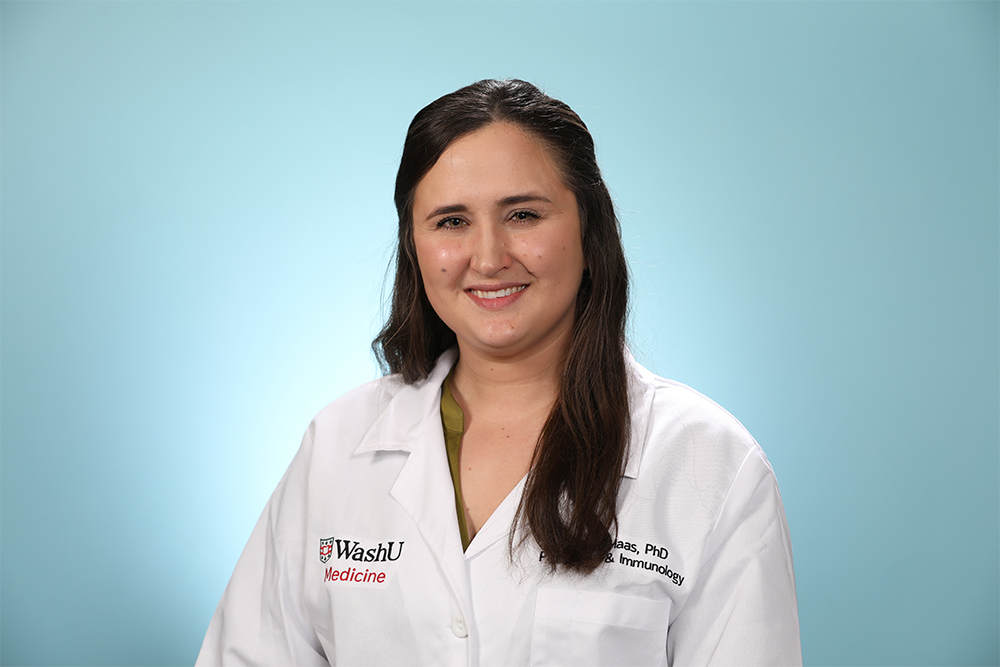
For this Faculty Feature, we highlighted Allison Haas, an Assistant Professor in the Laboratory and Genomic Medicine Division.
Tell us about your background. Where did you grow up, and when did you first become interested in science and medicine?
I grew up in a small town in Jasper, Indiana surrounded by cornfields. Our family had a small farm with horses, chickens, dogs, and a small herd of barn cats, so I spent a lot of time outside and with animals. Growing up, math and science always came quite easily to me. As a bit of a perfectionist (and a nerd as well), I would spend hours every night meticulously doing my homework to make sure there was nothing I missed. For a small town, we actually had access to a great hospital. By association, it always seemed like the most rational career choice was to go into healthcare. However, I was never interested in direct patient care. I learned more about the clinical laboratory during high school, and it seemed like the perfect combination to meld my love for STEM with healthcare and also a field that I could apply many of the things I was already learning in school.
I studied Medical Laboratory Science at Bellarmine University in Louisville, Kentucky and was the only undergraduate student of my year in that major. Due to the size, I was extremely lucky to get to spend a lot of one-on-one time with my professors. I quickly shared in the same love for this incredibly important, but often overlooked field that they did. Throughout my time there I got to be involved with many amazing experiences, including performing microbiology research in collaboration with local clinical microbiology laboratories. Prior to this, I was more interested in hematology and blood banking, but I quickly fell in love with the microscopic world around us and wanted to continue to learn more.
What is your career path?
I pursued a PhD in Microbiology and Immunology at the University of Pittsburgh in Pittsburgh, Pennsylvania in pursuit of more microbiology-related research. For my PhD I studied polymicrobial interactions in the cystic fibrosis respiratory tract – particularly how bacterial communities and inter-species interactions changed in response to respiratory viral co-infections, a known cause of pulmonary exacerbations in CF patients. Although I found my research interesting, I longed to be back in the clinical laboratory and much closer to patient care. I stayed connected to the local clinical microbiology laboratory during this time and always knew I wanted to find my way back to work in this environment again.
Following my PhD I started a Medical Microbiology and Public Health (ASM CPEP) fellowship at the University of Utah/ARUP Laboratories in Salt Lake City, Utah. As a national reference laboratory, I received amazing training in both routine and esoteric microbiology. There, I developed a keen interest in unusual organisms and am particularly interested in advancing diagnostics for organisms that are rare or challenging to diagnose. After fellowship I joined WashU as an assistant professor and assistant medical director in the Microbiology and Molecular Infectious Disease Laboratories where I oversee mycology, parasitology, vector-borne disease, and molecular virology testing.
What are your favorite parts of your current role?
I love working at WashU because there are so many amazing resources and people here. However, my favorite part of my role here is getting to work with trainees, including our micro fellows, path residents, and other visiting clinical fellows and residents. It’s very rewarding to help them work through challenging cases and help them discover their own passion for microbiology.
What is a memorable moment you’ve had while working in the department?
I am still very new to the department, but one moment that sticks out is early on seeing the excitement from the lab techs when they realized that I also had an MLS background, excited that I was “one of them”! It helped them know me and trust me a bit sooner, and I’m excited that we could have that connection. I will always have an immense appreciation for their work and knowledge!
What special skills or talents do you have that people may not know about?
For a scientist, I’m actually quite creative! I’ve always enjoyed making things myself rather than buying them. I enjoy baking, painting, decorating, or any other creative outlets.
What are some of your favorite hobbies or activities?
I love being outdoors and exploring nature and often find myself escaping the city for the quiet and spending quality time with my husband and our bulldog. We have enjoyed hiking many National Parks, but miss seeing and exploring the mountains every day like we did in Utah. I also love going antiquing for cool vintage finds. We have also been enjoying DIY-ing and redecorating our new house.
What is your advice to aspiring people in your field?
Reach out and get to know your local clinical microbiologist! This field is very well-connected and is very eager to mentor those who are interested. Because it is a small community, the earlier you get involved and start making connections, the better. Also, always be collaborative, open-minded, adaptable, and curious – microbiology is not always a straight-forward field and things change every day.